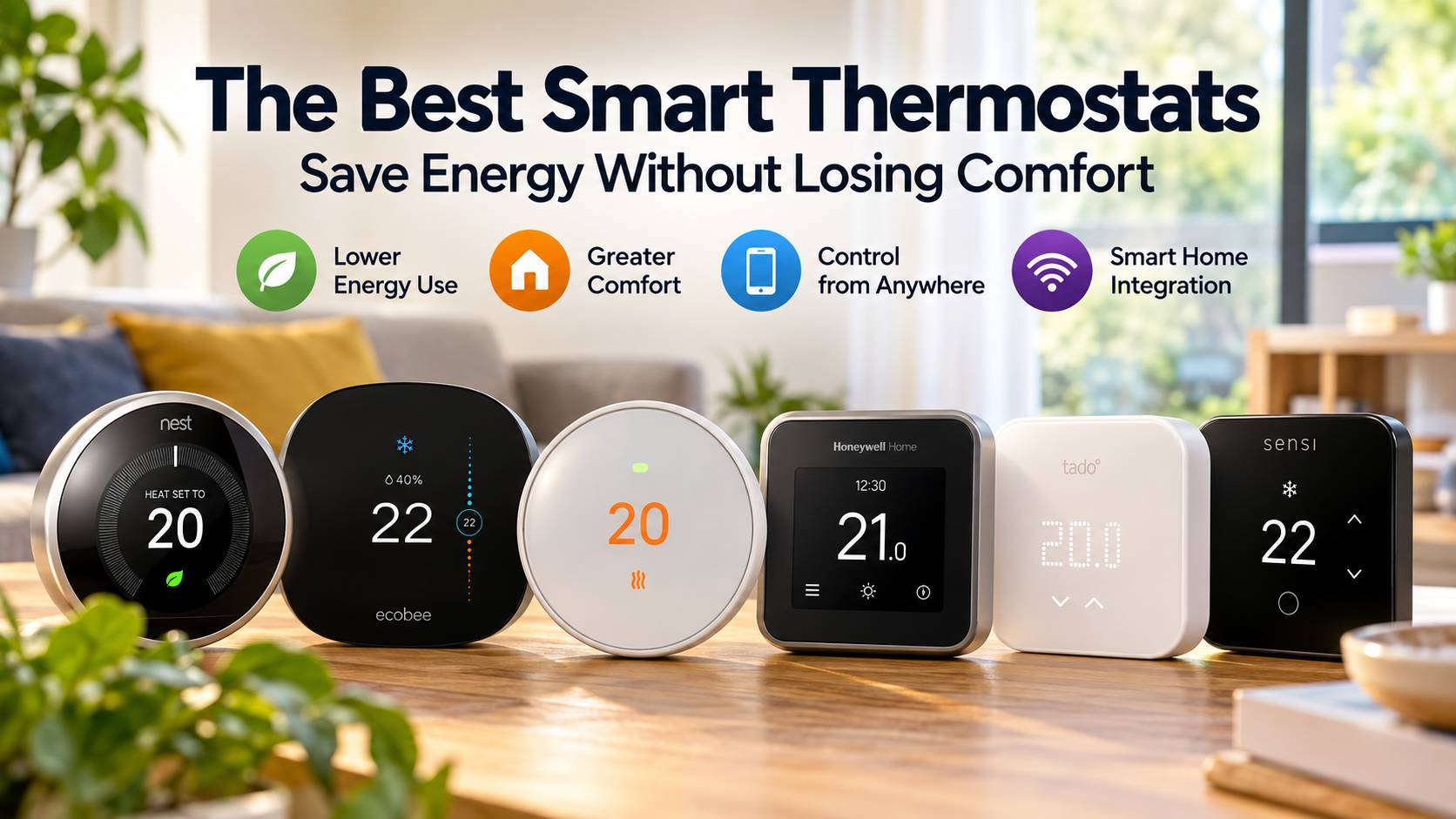
The best smart thermostats combine reliable temperature control with useful automation rather than simply adding Wi-Fi to a traditional thermostat. Our six selections cover North American 24V HVAC systems, heat pumps, European boiler systems and UK multi-zone heating. We considered compatibility, scheduling, occupancy detection, ecosystem support, installation and energy management. Good energy efficiency still depends on climate, insulation, HVAC performance, household habits and temperature settings, so no thermostat can guarantee a particular saving. ENERGY STAR likewise notes that savings vary according to climate, occupancy, equipment and comfort preferences.
Research checked: 6 October 2026.
6 Best Smart Thermostats at a Glance
| Smart Thermostat | Best For | Key Strength | Compatibility / Key Consideration |
|---|---|---|---|
| ecobee Smart Thermostat Premium | Best overall for North American HVAC | Room sensing and broad HVAC control | Most 24VAC systems; US and Canada |
| Google Nest Learning Thermostat (4th gen) | Best for learning automation | Smart scheduling and included room sensor | Most 24V systems; US and Canada |
| tado° Smart Thermostat X (2nd gen) | Best for European smart heating | Matter, Thread and expandable room control | Boilers, selected heat pumps and hydronic heating |
| Honeywell Home X8S | Best for advanced HVAC systems | Occupancy, room sensing and IAQ control | 24VAC; C-wire required |
| Drayton Wiser 2nd Generation | Best for UK multi-zone heating | Radiator, boiler and underfloor zoning | UK-focused system; hub-based |
| Netatmo Thermostat ORIGINAL | Best for straightforward boiler control | Simple scheduling and Matter integration | Dry-contact heating systems; mainly European markets |
How We Selected These Smart Thermostats
This shortlist is based on editorial research using current manufacturer product pages, compatibility documentation and recognised energy-efficiency guidance. We gave the most weight to HVAC or heating compatibility, heat-pump support, scheduling, occupancy or geolocation features, sensors, remote control, smart home integrations, subscriptions and regional availability.
We did not personally install or laboratory-test all six products, and the order is editorial rather than a mathematically calculated ranking. ENERGY STAR certification is useful where applicable because certified smart thermostats must demonstrate energy savings using real-world field data.
1. ecobee Smart Thermostat Premium — Best Overall for North American HVAC
The ecobee Smart Thermostat Premium stands out for homes that want strong HVAC compatibility and room-aware comfort. It supports most 24VAC equipment, including conventional heating and cooling, boilers, multistage systems and dual-fuel heat pumps. An included SmartSensor can prioritise occupied rooms, while eco+ provides scheduling and occupancy-based adjustments. It works with Apple Home, Alexa, Google Assistant and SmartThings. A C-wire is the preferred power source, although the included Power Extender Kit helps in many homes without one. ecobee officially sells and supports its devices only in the US and Canada.
2. Google Nest Learning Thermostat (4th gen) — Best for Learning Automation
Google’s fourth-generation Nest Learning Thermostat is particularly strong for households that want automated scheduling with minimal manual programming. It supports most 24V gas, electric, oil, forced-air, radiant and heat-pump systems, including multistage configurations, and includes a second-generation Nest Temperature Sensor. Matter support broadens smart-home control beyond Google Home. A C-wire is not required in most installations, although some systems need one or a Nest Power Connector. The main limitation is regional: this generation is officially available only in the United States and Canada.
3. tado° Smart Thermostat X (2nd gen) — Best for European Smart Heating
Released in September 2026, the tado° Smart Thermostat X (2nd gen) is designed for European-style heating rather than typical North American HVAC. The wired version supports relay and OpenTherm connections for compatible boilers, heat pumps and water-based underfloor heating. Matter and Thread make it particularly attractive for mixed smart-home ecosystems, while Smart Radiator Thermostats can extend control room by room. Advanced automation, including AI-driven geofencing and adaptive heating, sits within the optional AI Assist subscription. Existing V3+ owners should note that X-series devices are not backward-compatible with older tado° generations.
4. Honeywell Home X8S — Best for Advanced HVAC Systems
The Honeywell Home X8S is worth considering for more capable North American HVAC installations. It supports 24VAC systems including up to three heating and two cooling stages on compatible heat pumps, plus conventional forced-air and radiant hot-water systems. Occupancy detection, optional or bundled room sensing, energy reports and humidity or ventilation control give it greater scope than a basic Wi-Fi thermostat. It is Matter-certified and supports Apple Home, Google Home and Alexa. Unlike Nest, however, the X8S requires a 24VAC C-wire and does not support high-voltage electric baseboard heating.
5. Drayton Wiser 2nd Generation — Best for UK Multi-Zone Heating
Drayton Wiser is particularly well suited to UK homes built around boilers, radiators and separate heating zones. Its second-generation range includes kits for combi boilers, conventional boilers with hot-water control and multi-zone installations. Smart Radiator Thermostats and a dedicated underfloor heating controller make room-by-room expansion practical. Second-generation Wiser hubs gained Matter Bridge functionality in 2026, allowing Wiser devices to appear in Apple Home, Google Home, Alexa and SmartThings. Buyers should select the correct kit for their boiler and zone arrangement rather than assuming every Wiser package is interchangeable.
6. Netatmo Thermostat ORIGINAL — Best for Straightforward Boiler Control
Netatmo’s newer Thermostat ORIGINAL is a strong option for European households wanting straightforward connected heating without a highly complex interface. Wired and wireless versions support many individual boilers, air-to-water heat pumps and other systems using compatible two-wire dry-contact on/off control. Features include schedules, remote app control, heating reports, anticipation and Eco-Assist geolocation functionality. Matter integration is provided through the certified Thermo Hub. Compatibility should be checked carefully because this is not a universal HVAC controller, and the new ORIGINAL accessories are separate from Netatmo’s older thermostat ecosystem.
How to Choose the Right Smart Thermostat
1. Check HVAC Compatibility
Start with your heating and cooling equipment rather than the app features. A North American 24V HVAC thermostat cannot automatically replace a European boiler controller, and high-voltage electric heating often requires a specialist thermostat.
2. Check Wiring Requirements
Identify the existing thermostat terminals and voltage. Some products require a C-wire, while others use adapters, batteries, receivers or proprietary hubs. If the wiring is unclear, use the manufacturer’s compatibility checker or a qualified installer.
3. Compare Automation Features
Scheduling alone can be valuable. Learning behaviour, occupancy detection, room sensors and geofencing become more useful when household routines vary. Effective setbacks can produce genuine energy savings, but results vary significantly between homes.
4. Consider Smart-Home Compatibility
Check the exact product generation for Apple Home, Google Home, Alexa, SmartThings or Matter support. Matter can improve interoperability, but it does not remove HVAC wiring or heating-system compatibility requirements.
5. Calculate the Full Cost
Consider the thermostat, professional installation, room sensors, radiator valves, receivers, zone controllers and subscriptions. A cheaper thermostat can become expensive if a multi-zone installation requires numerous add-ons.
Frequently Asked Questions
Do smart thermostats really save energy?
They can reduce unnecessary heating or cooling through scheduling, setbacks, occupancy detection and similar automation. ENERGY STAR reports average savings of roughly 8% on heating and cooling bills for certified models in the US, but actual savings depend heavily on climate, equipment, occupancy and previous thermostat habits.
Can I install a smart thermostat myself?
Some models are designed for DIY installation, but the answer depends on voltage, wiring and the heating system. Straightforward low-voltage replacements may be manageable for experienced homeowners, while boiler controls, complex heat pumps, high-voltage heating and unfamiliar wiring can justify professional installation.
Do smart thermostats work with heat pumps?
Many do, including several products in this list, but heat-pump compatibility varies substantially. Check the number of compressor and auxiliary heating stages, backup heat type and manufacturer requirements. European hydronic heat pumps and North American forced-air heat pumps also use very different control arrangements.
Do smart thermostats require a subscription?
Usually not for basic temperature control and scheduling. Some manufacturers, however, reserve advanced automation, energy analysis, security functions or heat-pump optimisation for optional subscriptions. Check which features remain available without a paid plan before choosing a system.
Final Thoughts
There is no universal best smart thermostat. ecobee is particularly capable for North American HVAC and room sensing, while Nest is compelling for automated learning. tado° X and Drayton Wiser are better aligned with many European and UK heating arrangements, Honeywell Home X8S suits sophisticated 24V systems, and Netatmo ORIGINAL offers a simpler route into connected boiler control.
Compatibility matters more than ranking. Check voltage, wiring, heat-pump or boiler requirements, regional availability and the manufacturer’s compatibility tool before purchasing.
Editorial Disclosure
No affiliate, sponsorship or other commercial relationship information was supplied for this brief. The ordering above is based on editorial research. If the publisher has affiliate, advertising, manufacturer or partnership relationships with any listed brand, this disclosure should be updated before publication.
Review Disclaimer
This article is for informational purposes and reflects publicly available product information checked on 6 October 2026. Unless specifically stated otherwise, the thermostats were not personally installed or tested by the editorial team. Features, prices, subscriptions, integrations and regional availability can change. Always confirm compatibility with the manufacturer or a qualified heating or HVAC installer before purchasing.